When I tell people I teach natural birth control, I usually get one of two reactions. Either a raised eyebrow ("isn't that how people end up pregnant?"), or a very curious "wait, how does that work?"
Both are fair. Most of us were never taught how our own fertility works, so the idea that you can read it yourself sounds a bit like magic. It isn't. It's biology, and once it clicks, it's honestly one of the most empowering things you can learn about your body.
How it clicked for me
I still remember learning about this in a workshop. As soon as I got home, I started reading everything I could find, ordering books and researching, and within a few months I knew I wanted to teach other women. That's how I became a fertility awareness educator.
I've now been using this method myself for almost four years, and I still can't believe I didn't always know this, or that we aren't taught it in high school. It puts the power back in your own hands: the power of knowing your own body.
You're only fertile for a few days
Here's the thing that surprises almost everyone: you can't get pregnant every day of your cycle. Not even close.
- The egg only lives for about a day after ovulation.
- Sperm can survive 3 to 5 days inside your body, but only when your body makes the right kind of fluid to keep it alive.
So there's a short fertile window around ovulation each cycle. The symptothermal method is simply a way to find that window, with a safety margin on both sides.

Why a calendar (or most apps) can't do this for you
The idea that every cycle is 28 days with ovulation on day 14 is a myth. Real cycles vary, and stress, travel, illness or a few bad nights can all move ovulation.
That's why counting days doesn't work. A calendar guesses based on last month. The symptothermal method reads what your body is doing in this cycle, right now.
The two signs your body gives you
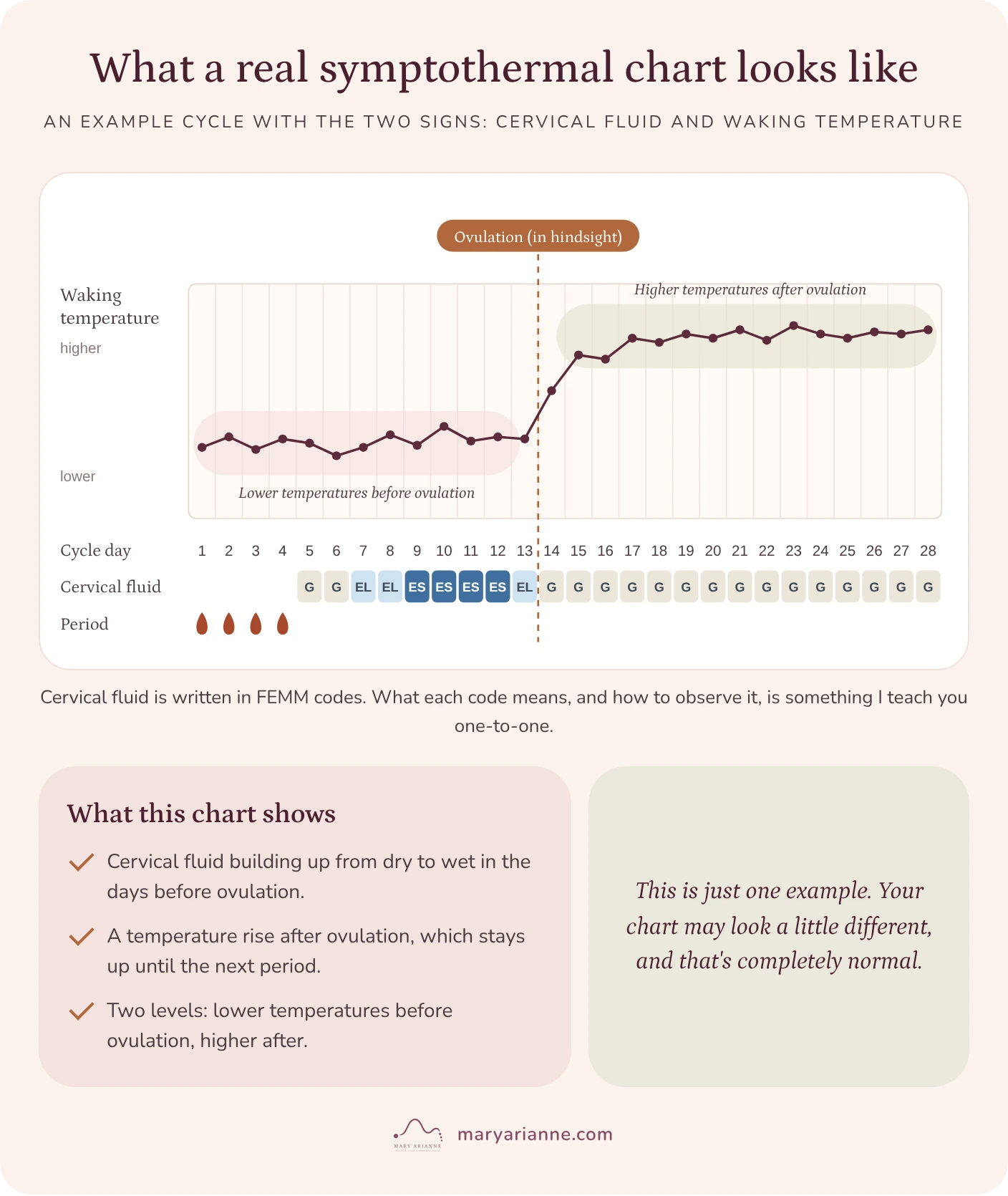
1. Cervical fluid: the heads up. As ovulation gets closer, your discharge changes. It becomes wetter and more slippery, a bit like raw egg white. This is your body's early warning that your fertile window is opening.
2. Your waking temperature: the confirmation. After ovulation, your body makes progesterone, which slightly raises your resting temperature. It stays a little higher until your next period. That rise tells you ovulation is behind you.

One sign warns you in advance, the other confirms afterwards. Together, they give you a clear picture. How you combine them into a daily "fertile" or "not fertile" is where the method's rules come in, and those are something you learn with guidance, not from an article.
How effective is it, honestly?
When it's learned properly and the rules are followed, the symptothermal method is up to 99.6% effective. That's in the same range as the pill. The best-known study, from Germany in 2007, followed 900 women for more than 17,000 cycles.
When people take chances on fertile days, it's less effective. So the difference comes down to two things: learning it well, and what you do on your fertile days.
Why tracking in an app isn't the same
Tracking your cycle for your health is something anyone can start today, and I love that more women are doing it. But using it as birth control is a different thing. That needs a proper method with clear rules, learned from someone trained to teach it.
Many apps predict your fertile days from your past cycles, which is exactly the guessing we want to avoid. A method is only as good as your understanding of it.


The app I do recommend: Read Your Body
If you want to chart in an app, this is the one I use myself, and the one I use with my clients. It's female-owned, it doesn't sell your data, and it doesn't make predictions. It's basically a really good notepad: a place to write down all of your own observations, so you can see your patterns clearly.
Every client of mine gets 3 months of Read Your Body for free. Have a look at Read Your Body.
A bonus: your chart tells you so much more
Once you can read your chart, it becomes a window into your health. Do you ovulate? Is the second half of your cycle long enough? How does stress show up? It's information you can take to your doctor, and it's yours for life.
Want to learn it properly, with someone by your side? My Natural Birth Control programme teaches you the symptothermal method one-to-one over 12 weeks, with six months of support. Not sure yet? Book a free 30-minute call and ask me anything.